Showing posts with label Budapest. Show all posts

Tuesday, October 31, 2017

Halloween in Budapest - Jack-O-Lantern Festival in Heroes' Square

In celebration of Halloween, today's post looks at seasonal festivities in some of Budapest's well designed public spaces. 


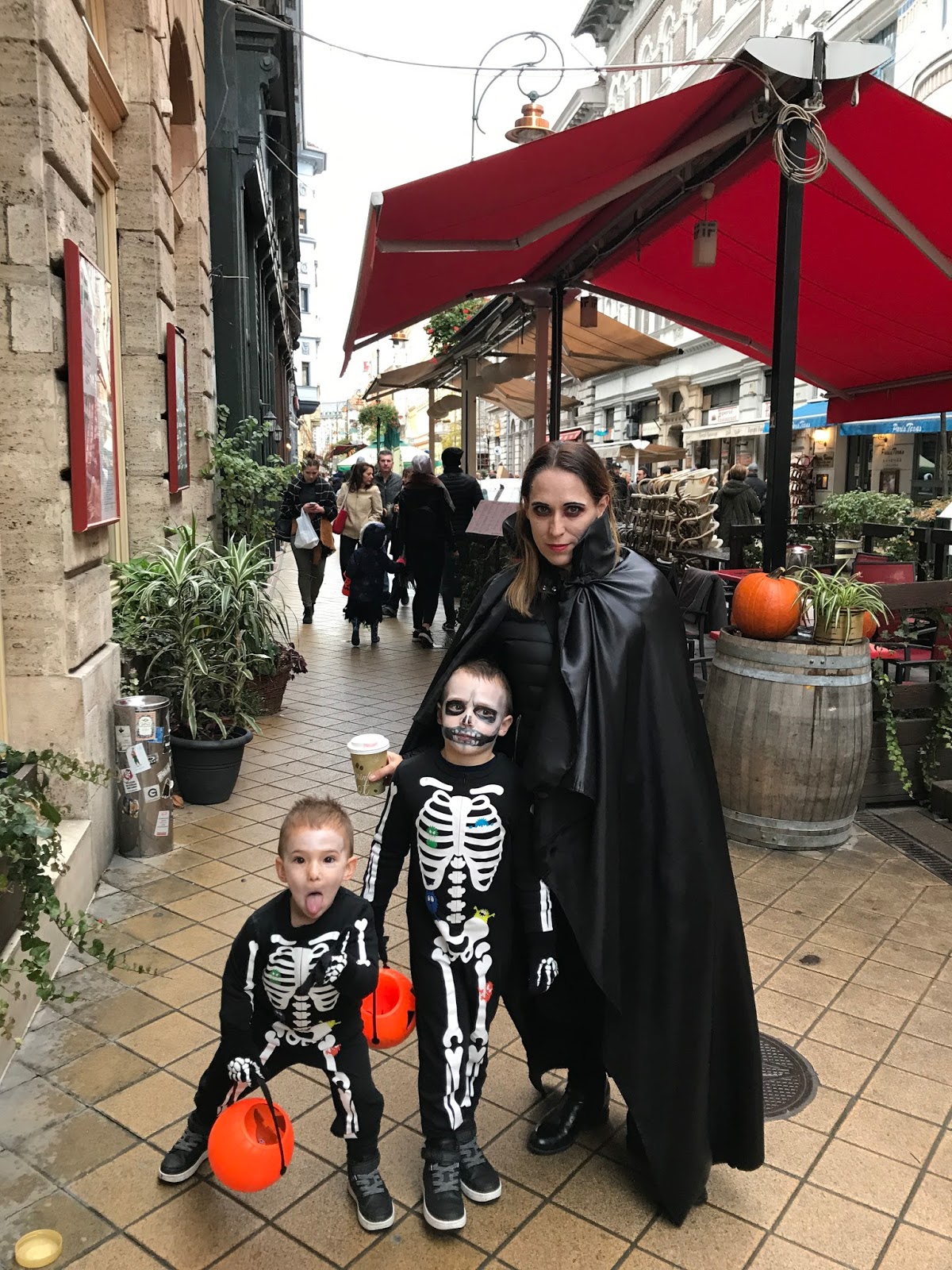
Halloween has only recently begun to be celebrated in Budapest. My wife and I had a great time this year dressing up our kids in costumes and enjoying the festivities like trick-or-treating on Raday Utca - one of the city's beautiful restaurant-lined streets.

We ended our evening at Budapest's Heroes' Square - one of the city's main signature public spaces - which is grandly flanked by porticoed museums and terminates a marvelous multi-way boulevard.


The square is used throughout the year for a variety of concerts, shows and other events. I wrote a while back about how Heroes' Square is closed to traffic and transformed into a horse track for the annual Nemzeti Vagta (National Gallop) celebration:


Well, for Halloween, Heroes' Square is the site of a wonderful, spontaneously-organized Jack-O-Lantern Festival.


Many people have recently begun carving Halloween pumpkins with their children, and wanted a place to share their creations. Heroes' Square, as one of the public 'living rooms' for the city, seemed like just the place.

Today, hundreds of people show up at Halloween and place their lighted Jack-O-Lanterns on the pedestals of the various Belle Époque monuments. Crowds slowly circulate to marvel at the display, take photographs and discuss their favorites.


A great ending to a great day celebrating Halloween in Budapest!

Friday, January 27, 2017

"The Sense of Proportion is the Chief Artistic Sense"

Proportional study sketches from master drawings, paintings and built works of architecture are some of the best possible exercises for one's sense of proportion.  I try to do them whenever I can.  
Simple tools - just a pencil and sketchbook are all that is needed.  Here are some examples from my travels:

Proportional study sketch by James Dougherty from the painting Portrait of a Young Man – by Hans Holbein the Younger in the National Gallery of Art, Washington DC


Julien Guadet (1834-1908), the esteemed French architect, theoretician and Professor at the École des Beaux-Arts, Paris writes in his four volume masterwork Éléments et Théorie de l'Architecture:

"The sense of proportion is the chief artistic sense.  Proportions are infinite and delicate in art and are still more so in nature.  

How do you recognize a friend among all the people you see, even though you see millions pass?  A question of proportions alone.  But proportions are so infinite and variable, that among millions of heads no two are exactly alike.  

Nothing develops a sense of proportion like practice in drawing.  To draw is to perceive and then express those specific proportions that distinguish and identify the model.  The best draftsman is the most sensitive to proportions."


Proportional study sketch by James Dougherty from the sculpture Theseus Battling the Centaur - by Antoine-Louis Barye in the High Museum of Art, Atlanta GA


Proportional plein air study sketch by James Dougherty of Budapest's Chain Bridge - designed by William Tierney Clark


Proportional study sketch by James Dougherty from the sculpture Nymph of the Fields - by Carlo Pittaluga in the National Gallery of Art, Washington DC

Amazon: Éléments et Théorie de l'Architecture


Wednesday, September 21, 2016

Budapest Car-Free Day / European Mobility Week 2016


This past weekend, my wife and I took our sons to Budapest's annual "Autómentes Napot" or "Car-Free Day" festival:


The centerpiece of the festival occurred Budapest's grand Andrassy Boulevard, which for the weekend is closed to cars and converted to a pedestrian and bicycle thoroughfare:


For almost 2 1/2 kilometers, the beautiful street is filled with food, drink and fun and engaging activities and displays for the public that focus on methods for reducing energy consumption, emissions, and carbon footprint:


The event was a hit, with thousands in attendance:


In the month leading up to the festival, I had the opportunity to volunteer some time and help one of the main organizers, Zsolt Kovács of A-Z Produkció, to help design the arrangement of the exhibits and other facilities for the central area of the event:


Nemzeti Vágta:

Budapest's Car-Free Day coincides with the "Nemzeti Vágta" or "National Gallop" which occurs in the stunning Hero's Square at the termination of Andrassy Boulevard:


The square is closed to traffic and converted for the weekend with into a truly grand horse racing track featuring riders in traditional garb.  It is a spectacular example of how flexibly a well-designed public space can be used:


Budapest's Car Free Day was just one event that was part of the much larger annual "European Mobility Week".   Over 2,000 cities and towns across Europe participated this year.  Hungary was one of the countries with the greatest level of participation, with 214 cities and towns taking part.


As described on the event's website, each European Mobility Week focuses on a particular topic related to sustainable mobility.  Local authorities are required to organize activities for their citizens based on this theme. They are also encouraged to launch and promote permanent measures that support the theme.

This year's theme is "Smart and sustainable mobility – an investment for Europe" and focuses on the connection between smart mobility and a strong economy. 

Interesting observations by the event's organizers include:

  • Strengthening local economies is a universally popular goal, but one that many feel lies outside of our control as individuals or communities. Research shows, however, that by making smarter mobility choices we can notably boost public finances.
  • Studies indicate that cities that promote sustainable transport are at a significant economic advantage over those that favor traditionally fueled cars. People who travel by active transport modes, such as walking and cycling, are not only more productive at work, they also take fewer sick days and spend less time on average in the doctor’s office.
  • And the benefits go far beyond better health. Property values in cities with good cycling facilities and efficient public transport tend to be higher, while children who walk or cycle to school perform better in class.
  • Prioritising sustainable transport also benefits the private sector. Reports reveal an increase in trading of up to 40 percent in areas where walking and cycling become the norm. In Copenhagen (Denmark), customers who travel to cities by bicycle spend €2 billion per year - more than those who travel by private vehicle.
  • From a governmental standpoint, investing in infrastructure for active travel, encouraging public transport use to reduce traffic congestion, and supporting bike-to-work schemes can save public money and boost local commerce.

Tuesday, February 23, 2016

Outdoor Bus Stop Cycle Gym

A cool idea seen here recently in Budapest: 


At a downtown Pest bus stop near our apartment, a small outdoor built-in cycle gym was installed so people waiting for their bus can pedal and get a bit of exercise!


The sign on the bus stop translates roughly to "You missed your bus...while you wait, give the pedals a push!"


The customized bus stop was interestingly installed by the Coca Cola company, who have an ongoing public health campaign in Hungary titled "Testébresztő" or "Wake Up Your Body!"  They're encouraging healthy lifestyles that incorporate greater levels of physical activity.

Click here for a link to the Coca Cola company's health campaign website - which features a short video about the bus stop installation among their other projects.

Tuesday, February 2, 2016

"We have bad weather - people won't walk here!"

This is one of the familiar refrains I often hear in car-oriented places where plans for the development of new walkable urbanism are being proposed.

It can often really be hard for people living in places designed around automobile dominance to imagine that, with the right built environment, traveling on foot could be possible (even pleasant!) in challenging weather.  

I want to share a reassuring typical winter snapshot from last week here in Budapest: 


This is the Szent István körút, one of Budapest's large ring avenues.  (4 lanes of traffic, plus dedicated center tram lines and outer bus / bike lanes).  

The temperature is 18 degrees Fahrenheit (-7 degrees Celsius), and the sidewalk is covered with a layer of ice and snow:

Though the temperature is quite cold, all that is required for comfort are a few layers of winter clothing.  People (including my 4-year old son Benji in the red hat) are going about their normal daily routines and enjoying their stroll along the broad sidewalk.

The key is a built environment that is specifically designed to be comfortable for people on foot.  

The relatively simple but powerful ingredients are time-tested:  

  • The street space is well-shaped by buildings to form an embracing "outdoor room".
  • Plentiful front doors and windows face the street to add liveliness.
  • Sidewalks are generous in width.
  • Well-placed trees and bollards protect people on foot from moving cars.
  • There are interesting shops, signs, architectural details and people to look at.
  • A rich mix of uses helps provide places to occasionally step in out of the cold.

BTW: If you're interested in learning more about the design details of great streets, I highly recommend the book Street Design: The Secret to Great Cities and Towns by Dover, Kohl & Partners' own Victor Dover and his co-author John Massengale:

Tuesday, January 19, 2016

Ice Skating Pavilion as Civic Architecture

The best new traditional neighborhood developments (TNDs) feature a sprinkling of extraordinary focal architecture amid a setting of more ordinary background buildings.  Focal architecture provides visual spice to the physical design of a neighborhood and results in landmarks that make a place more memorable and legible.

This can be seen in the image I drew below of the civic meeting hall in Dover, Kohl & Partners' Lowcountry project Kerr Village:


It is often a challenge, though, to find uses to inhabit these focal sites.

Here is a beautiful historic example for consideration, that provides warmth and joy during the colder months of the year.  The Pavilion of the City Park Ice Rink (Városligeti Műjégpálya) in Budapest:


The gorgeous Neo-Baroque Pavilion building was designed by Imre Francsek in 1895 for Hungary's Millennium Celebrations marking the 1000th anniversary of the Magyar conquest of 895.

The Pavilion features a grand tripartite central mass crowned by elaborate compound domes with finials.  This central mass is flanked by two smaller octagonal domed masses connected by long linking arms.  The resulting focal yet broad composition embraces the ice skating ring and imbues the large space with a sense of charm, intimacy and warmth.  (To see a more in depth discussion of the articulation of architectural massing types click here). 

A historic image of the Pavilion can be seen in this 1895 commemorative etching of the grounds of the Hungarian Millennium Celebrations.  The Pavilion is at the bottom center of the image just to the right of the exedra of the Heroes' Square monument and the bridge marking the grand entrance to the Exposition grounds:


The ice skating rink and Pavilion were so popular during the Millennium Celebrations, they were afterward made into permanent fixtures of the City Park.  

Today, the Pavilion building still houses ice skating equipment rentals and changing facilities, as well as a restaurant, cultural center and an events hall.  While it continues to serve one of Europe's largest ice skating rinks in the winter time, the Pavilion is now also used for a wide variety of cultural programs throughout the entire year.

Wednesday, August 26, 2015

The Most Beautiful McDonald's in the World

When one thinks of sensitive rehabilitation and reuse of historic structures, McDonald's is not usually a company name that immediately comes to mind.  The American fast food company, however, deserves a great deal of credit for its elegantly-implemented restaurant in the historic Nyugati Train Station (Nyugati Pályaudvar) in Budapest:


The beautiful iron and brick Beaux-Arts train station was originally designed by August de Serres and built by the Eiffel Company.  The station first opened on August 28th, 1877 (12 years before Gustave Eiffel would go on to build his famous Tower in Paris for the 1889 Exposition Universelle).  The train station features a soaring, airy iron-ribbed central hall and a series of majestic and well-organized passenger ticketing and waiting spaces:


The station is embedded seamlessly into Budapest's urban fabric and fronts directly onto the sidewalk of the Grand Ring Boulevard (Nagykörút).  For this reason, the station is very convenient for passengers to access by foot, street car (Villamos), and bicycle.  As with many well-designed urban train stations, the vast majority of passengers arrive by these means, rather than by automobile:


During Hungary's post-WWII decades behind the Iron Curtain the Nyugati train station, like many structures in Budapest, grew in need of renovation.  The McDonald's corporation was one of the very first Western companies to establish itself in Budapest during Hungary's transition away from Communism upon its declaration as a Republic on October 23rd, 1989.  McDonalds' very visible location in one of the main train stations in Budapest was a potent symbol of the country's re-connection with the West:


The McDonald's corporation deserves accolades for the careful manner in which it painstakingly restored the architecture of the Nyugati Train Station's former dining hall, preserving the gorgeously-detailed original exterior as well as virtually the entire elegantly vaulted and ornamented interior.  This respect of the train station's magnificent historic architecture has earned the restaurant the affectionate moniker among locals as "The most beautiful McDonald's in the world".


Note: Click here to see my post on: The Most Beautiful Home Depot in the World!

Thursday, August 20, 2015

A Water Tower Can Be A Delightful Landmark?

Here's an example!

Budapest's Margaret Island sits in the middle of the Danube River as it runs through the City.  The island was once settled during the Medieval period as a religious center, but during more recent history has evolved into a verdant reprieve - filled with parks, gardens, recreation and cultural facilities utilized by the whole city - similar to New York's Central Park.

One of the main landmarks of Margaret Island is its famous water tower. Constructed in 1911, it was designed in a stunning Art Nouveau / Secessionist style by the Hungarian architect Rezső Vilmos Ray.  Ray remarkably achieved both the functional utility of reliable water supply to the island, while also creating a breathtakingly beautiful lookout tower designed to give visitors sweeping views:


The 187 foot (57 meter) high water tower has a capacity of 158,503 gallons (600,000 liters), and was remarkably also the first building in Hungary to make use of reinforced concrete, a new technology at the time.  

The beauty of the architectural expression of the water tower has made it a universally cherished local landmark. It has been incorporated into a marvelous new open air theater and underwent a renovation in 2012.  It is open to visitors to this day as a lookout tower.