Showing posts with label urban design. Show all posts

Friday, September 20, 2019

Historic Central European Cities and Towns: Beauty + Superior Environmental Performance

As towns and cities grow, the pattern chosen for new urban development has a large impact on environmental footprint.

Over the past few years living in Central Europe, I’ve been fortunate to explore the historic cities and towns here in Hungary a good bit with my family. We’ve discovered that there are a number of really spectacular gems of urbanism and architecture worth study. 


Pécs, Hungary


Szeged, Hungary


Eger, Hungary


These places offer valuable lessons on how to build cities and towns that are not only charming and beautiful - but simultaneously provide superior environmental performance.  

Here's a brief video explaining reasons why the designs of these historic cities and towns often perform so well environmentally, compared to contemporary suburban patterns:


Though many of these places started as Roman or medieval settlements, most of them were greatly expanded and embellished relatively recently during Hungary’s equivalent of the Belle Époque in the late 1800s when Austria-Hungary experienced a prolonged period of prosperity. 

Below are Google Maps view links to some of our favorites places to visit. 

Note: When you click on a link to explore an example in Google Maps, I recommend looking at the urban pattern from above, and also using the "Street View" function to drop down and explore the beautiful character of the streets and spaces from the ground.


1. Budapest: [Click to Explore in Google Maps]

Budapest set the tone for architecture and urbanism in Hungary during the late 1800s.  It’s grander in scale (4 to 6 stories tall) than the smaller cities and towns (usually 1 to 4 stories tall), but there are otherwise many similarities in the design language.  The most common building type is a mixed-use, attached type that features a central courtyard with open galleries at each floor level.  This building type facilitates a very efficient use of the land in a very pleasant low-rise format.

The architectural design of the façades usually reinforces the legibility of the urban structure while also giving each (otherwise relatively similar) building a unique and often very beautiful individual expression.


Next is a selection of smaller Hungarian cities and towns. I think the physical design of Hungary’s smaller cities and towns provides really wonderful design inspiration, and there are many examples of efficient use of mid-block areas frequently employing mid-block passages, or mews, of various configurations.  


I hope you find this brief tour helpful and enjoyable!


Monday, May 28, 2018

Architectural Design Techniques of Urban Buildings in the Late 19th and Early 20th Century


I'm very excited to present a new paper I've written titled:

Architectural Design Techniques of Urban Buildings in the Late 19th and Early 20th Century

This illustrated essay explores specific physical design techniques employed by architects during this golden period of city-building to achieve their remarkable results.

It has just been published by Periodica Polytechnica Architecture (a peer reviewed scientific journal published by the Faculty of Architecture of the Budapest University of Technology and Economics).


https://pp.bme.hu/ar/article/view/11830/8025

Urban buildings constructed in historic city centers of Europe and America in the late 19th and early 20th Century demonstrate a remarkable consistency of architectural excellence and harmony which can be observed from the large urban forms down to minute details. 

https://pp.bme.hu/ar/article/view/11830/8025

The comprehensive system of design principles employed by architects of the time in the creation of these buildings has resulted in urban environments that achieve a very high degree of functionality as well as adaptability to the evolving needs of their modern populations.

(Note: For those who are interested in delving even deeper, Section 3 of the essay focuses on the rediscovery of lost classic architectural design instructional texts and contains a recommended reading list). 

Tuesday, November 7, 2017

Connecting Passengers To Their Train Platform Seamlessly: Vienna's Hauptbahnhof Station

This past weekend, I visited Vienna with my wife and kids. We traveled by train and arrived at the new Hauptbahnhof train station (image from Wikipedia):

The sleek, bustling new central station, conveniently surrounded by a cluster of new transit oriented development, consolidates boarding to international trains traveling north, south east and west from the city. It also connects directly to Vienna's metro, streetcar, bus, bikeway and pedestrian systems:


One of the details that I was particularly impressed with was the well-thought-out access for passengers to the station's 6 train platforms that run parallel to one another.

Typically in such arrangements, there is a lower pedestrian access passageway that links the platforms; but often this passageway can be dark, unattractive and occasionally unsafe-feeling if there is a lack of natural surveillance.

The designers of Vienna's Hauptbahnhof train station solved this issue by converting the lower passageway into a bright, airy multi-level shopping hall. Stores and cafes line the sides, making the space feel lively while providing travelers with useful goods and services and a great diversion to pass the time while waiting for one's train departure time.


Running down the center of the shopping hall are a series of glass elevators and escalators marked with the numbers of the various train platforms. When it is time to board a train, one need only go up a level, and then walk out right onto the platform:


This seamless connection for passengers to the train platform is a wonderful innovation that helps keep every step of travel by train to Vienna a high quality experience:


The Vienna Hauptbahnhof train station's website has a cool 3D image tour of the construction process. (click here to take the tour)

Tuesday, October 31, 2017

Halloween in Budapest - Jack-O-Lantern Festival in Heroes' Square

In celebration of Halloween, today's post looks at seasonal festivities in some of Budapest's well designed public spaces. 


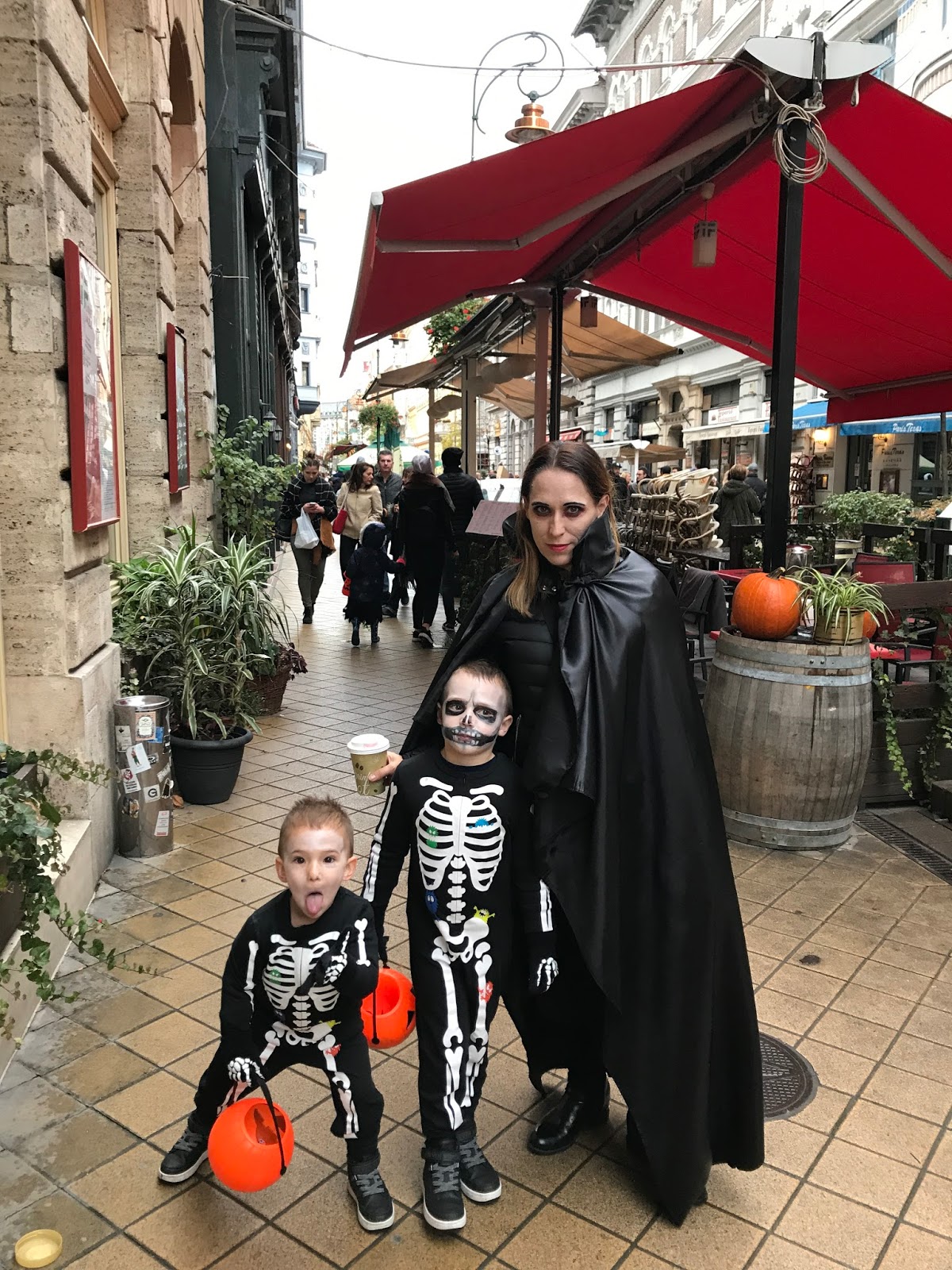
Halloween has only recently begun to be celebrated in Budapest. My wife and I had a great time this year dressing up our kids in costumes and enjoying the festivities like trick-or-treating on Raday Utca - one of the city's beautiful restaurant-lined streets.


We ended our evening at Budapest's Heroes' Square - one of the city's main signature public spaces - which is grandly flanked by porticoed museums and terminates a marvelous multi-way boulevard.


The square is used throughout the year for a variety of concerts, shows and other events. I wrote a while back about how Heroes' Square is closed to traffic and transformed into a horse track for the annual Nemzeti Vagta (National Gallop) celebration:


Well, for Halloween, Heroes' Square is the site of a wonderful, spontaneously-organized Jack-O-Lantern Festival.


Many people have recently begun carving Halloween pumpkins with their children, and wanted a place to share their creations. Heroes' Square, as one of the public 'living rooms' for the city, seemed like just the place.

Today, hundreds of people show up at Halloween and place their lighted Jack-O-Lanterns on the pedestals of the various Belle Époque monuments. Crowds slowly circulate to marvel at the display, take photographs and discuss their favorites.


A great ending to a great day celebrating Halloween in Budapest!